Work
Seven projects across four restaurant brands. Each one includes the moments it came from, the trade-off inside it, and the decision rule I took away from it.
Shoot more than you need.
Value created — Gave the edit real options instead of one viable take, so more usable content came out of the same booked shoot time.
One industry. Different brands.
Value created — Gave each venue material that argues its own case, so the group's brands stop competing for the same customer with the same message.
Before they walk through the door.
Value created — Identified friction in the discovery-to-booking journey and handed the team a prioritised list of fixes rather than a general critique.
The second visit matters too.
Value created — Gave the team a concrete, discussable version of group-wide retention — including cross-brand logic that turns one venue's regular into another venue's first-time guest.
Who are we actually talking to?
Value created — Gave the team clearer options for audience targeting, and a distribution routine so posts went out with a defined audience and timing.
Working smarter with AI.
Value created — Made ideas testable early — the team could react to a working version instead of imagining a description.
A page, not a post.
Value created — Made the content system easier to continue after my internship: repeatable formats with success measures, not a list of one-off posts.
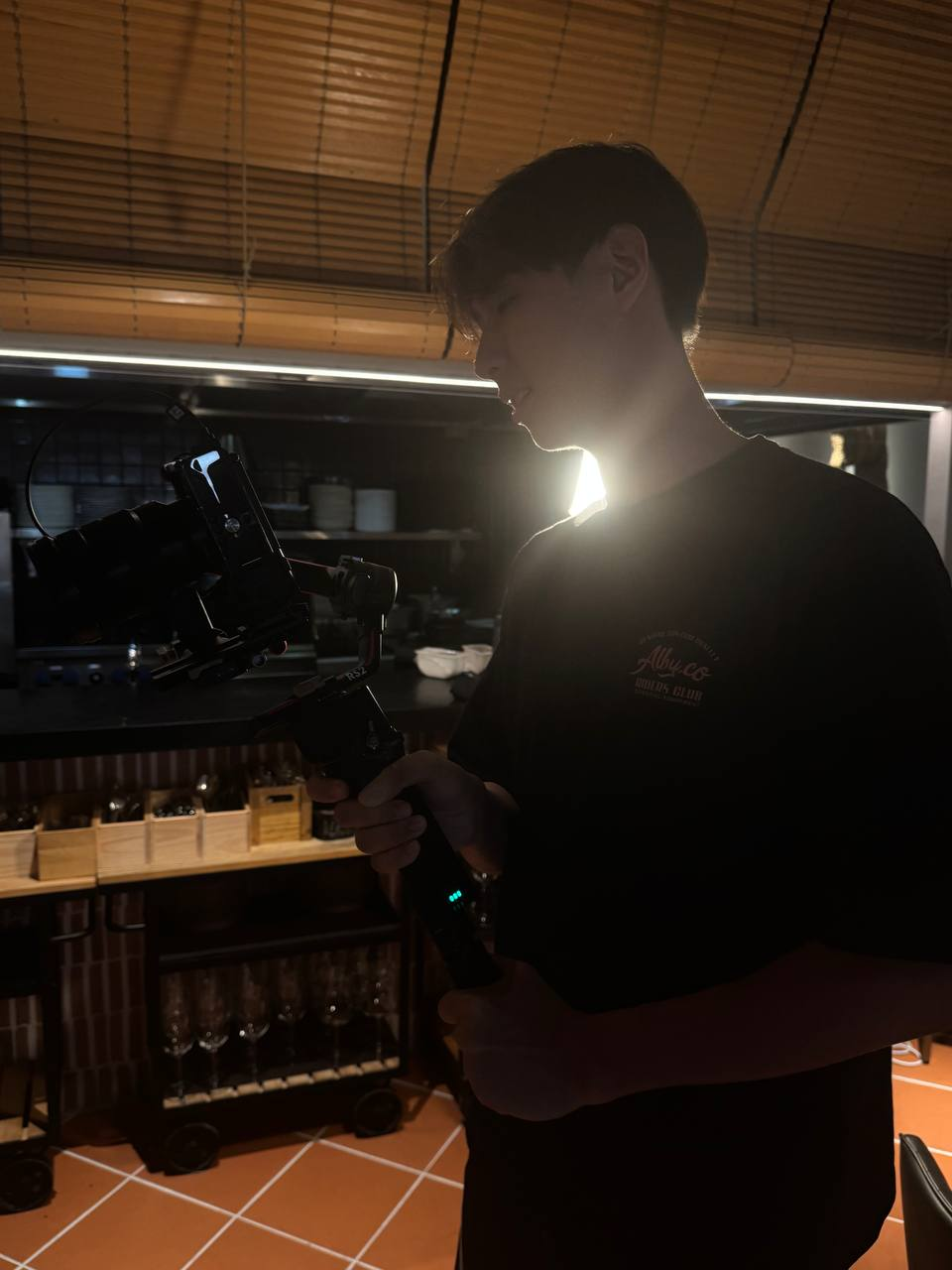
At an event nothing can be reshot. The skill stops being the camera and starts being noticing what is about to happen.
The small decisions
that changed my work.
None of these are strategies. They are habits I did not have in Week 1.
Film more than the final edit needs.
Not every clip survives the edit — shaky, too short, or three versions of the same frame. Extra angles are the only thing that makes a shot recoverable after the food is gone.
Set up before the food arrives.
A dish has a short window where it looks its best. Testing light and settings on an empty plate turns that window into filming time instead of setup time.
Adapt the edit to the brand, not the brand to the edit.
Pacing, music and colour carry positioning. Reusing a successful edit style across venues is faster and quietly makes four restaurants sound like one.
Ask before assuming.
I lost work in Week 6 by assuming what was required. A few minutes clarifying the direction costs far less than rebuilding a finished version.
Show the rough version early.
Feedback on a storyboard or a structure is cheap. Feedback on a completed project means unwinding decisions that have already been built on.
Check the customer before the tool.
A platform, a template or an incentive is only useful if the communication is relevant. Choosing the mechanism first tends to produce a solution looking for a problem.
Contribution,
not just participation.
Nine areas of work, each with the need behind it, what I actually did, and what it taught me.
Content production
Restaurants need a continuous supply of usable footage, but a dish can only be plated once and a dining room can only be occupied for so long.
Filmed food, venues, a live collaboration dinner and a shoot with the owners and chefs — running two cameras where possible and deliberately capturing extra angles, distances and takes.
The edit had genuine alternatives rather than one viable version of each scene, which reduced the risk of discovering a missing shot after the shoot had ended.
Decisions made on set determine what is possible in the edit. Coverage is a planning problem, not a reflex.
Video editing
Content for several distinct brands was being produced from similar-looking shoots.
Edited to each restaurant's identity — adjusting pacing, music, transitions and clip selection per brand rather than applying one house style.
Content left the edit already aligned to the brand it represented, so less had to be corrected later.
Editing is a positioning decision. The same footage can say two different things about the same restaurant.
Website and SEO
Chicco, Casa Mori and Il Toro each needed to communicate their positioning, menus and booking pathway clearly to people who had never visited.
Reviewed each site against the customer journey and recommended clearer concept communication, stronger titles and descriptions, more accessible menus and more visible booking routes.
Gave the team a priority order based on where customers are most likely to drop out, rather than a flat list of technical fixes.
Ranking and converting are separate problems. Being found does not mean being chosen.
Menu design
Menus across the group needed updating and were being produced inconsistently.
Rebuilt and updated menus in Canva with attention to spacing, font size, layout and image placement.
Made menu updates faster to repeat and the results more consistent with each venue's positioning.
A menu is a branding surface customers actually read closely, both online before booking and at the table.
Digital advertising
Campaigns risked using the same targeting for restaurants with very different customers and occasions.
Sorted and filtered customer profiles in Meta Ads Manager to build separate audiences by restaurant, interest, occasion, location and previous engagement.
Made audience definition a deliberate step alongside the creative rather than a setting applied at the end.
Who sees the advert changes what the advert should say. Targeting is a marketing decision.
Customer communication
WhatsApp is a direct line to customers and easy to misuse on a channel people reserve for people they know.
Wrote WhatsApp marketing messages for lunch sets, new menus and reservation reminders, alongside captions and hashtag sets, and scheduled publishing through Metricool.
Gave the team messages that were short, specific and action-focused, and a scheduled plan rather than ad hoc posting.
On a personal channel, length reads as pressure. Relevance and timing are part of the message, not packaging around it.
Loyalty and retention
The group wanted a loyalty programme that could work across restaurants with very different price points and customer profiles.
Researched other restaurant groups, built a mock membership system with group accounts, points wallet, status and brand-specific rewards, and produced slides setting out the segmentation and cross-brand reasoning.
Turned a general intention into a concrete proposal the team could interrogate — including the argument that rewards must differ by brand to protect premium positioning.
Loyalty designs behaviour. The mechanic has to be chosen after deciding which behaviour is worth paying for.
Events and development
Humo, Chicco and Il Toro needed to be presented as private dining and group event venues, in a form a customer could compare.
Built the events kit and the Events Toolkit draft website covering venue descriptions, capacities, spaces, event types and experience, then revised both against feedback to align with Cantera Collective's branding.
Gave the team a usable draft to react to rather than a description, and organised the information around how customers compare venues.
A first version's job is to reveal what needs to change — and work should be judged on whether it is usable by a real customer, not on whether every section is filled in.
Social strategy
Chicco's TikTok had strong visuals but no repeatable system, so nothing accumulated between posts.
Developed and revised the TikTok growth strategy around recurring series, hook-led openings, human entry points and search-aware captions, then filmed storyboard reenactments and original footage to test the concepts.
Moved the account from individual posts towards formats the team can repeat, and showed which concepts survived being filmed before further time was spent on them.
Ideas have to be tested cheaply. A concept that works on paper can fail on pacing alone.